Showing posts with label Literature. Show all posts

Sunday, 29 May 2011

Epic Fails of Ancient Rome: How (not) to buy the throne

How does a man become emperor? Generally speaking he either has to be proclaimed a successor by the current emperor, or he can seize the city of Rome with an army and force the government to declare him emperor. Simples.

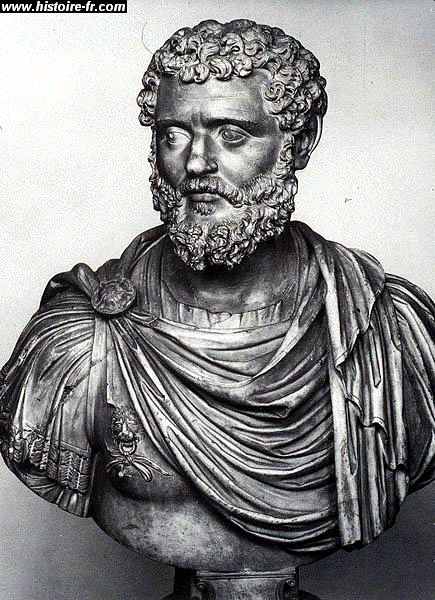
But in the year 193 A.D one chap, Marcus Didius Severus Julianus Augustus (let’s call him Didi to save words), attempted to break the mold, he went against the grain by choosing to buy the imperial throne and the empire that came with it.

Now, Didi was from a prominent family and had a high-flying career that befitted a man of his status. He followed the cursus honorum – a traditional career path for any aspiring politician that gave all the experience necessary for a government career.  He had worked both at home and abroad, in administrative and combat roles; in short he was a viable candidate for emperor.



So how do you buy the throne?

Step one – find out who owns it
Nearly a century before Didi’s purchase, the emperor Claudius had worked out just who actually owned the throne. The Praetorian Guard. These men based just outside Rome were the only major military force for hundreds, if not thousands of miles around.  In principle they protected the emperors life but they were also known to take it if it benefitted them. When power changed hands between emperors it was the Guard who had the final say, and by this period they received a donation from each emperor. They were wealthy, and their commanders were hugely influential.


Step two – wait for an opportunity to purchase it
Didi’s predecessor, Pertinax, was assassinated by the Praetorian Guard. The reasons vary but a tightening of discipline and a failure to provide them with a promised sum of pay are both possibilities. A force of them stormed the palace one night and took his life.

Afterwards the Praetorian Guard proclaimed that the throne would be sold to the man who paid the highest price. This was Didi’s opportunity.


Step three – attend the auction
Naturally there would be some competition for the position of emperor, ruling the world was a popular job back then and the entry requirements were (financially) extraordinary. Titus Flavius Sulpicianus was the first to attend the action at the Guard camp. He was Pertinax’s father-in-law and Prefect of the City so he had a strong claim.

Meanwhile Didi was chillaxing at a banquet when his family rush in and tell him what is happening. He dashes to the senate-house to be told that the auction is taking place at the Guard camp. So there he dashed.


Step four – bid big
Sulpicianus was already close to clinching the deal and Didi couldn’t get into the camp to make his bid. So he stood beyond the wall and made various promises to win the Guard over. Ancient sources offer us various claims but the financial one is the most important, 25,000 sesterces to every Guardsman! 
This is a difficult bid to believe, there were 9,000 guardsmen, so that makes a whopping 225 million sesterces! 


Attempts to convert values like that into modern terms don’t work*, some rough calculations suggest that Didi could have purchased forty-five Italian estates (so basically most of Italy) with that amount of cash. Did he even have that much money? We will never know, but upon his accession to the throne he did debase the currency by 6.5%, shaving a nice 14 million in value off of his still unpaid bid, despite the public outcry about it.


Step five - prepare for civil war
So with all four of these steps completed, you too can own Europe (and a bit of Africa/Asia), however you won’t get to have it for long, probably only a few months, as Didi unfortunately found out.

You see, he and Sulpicianus weren’t the only ones who wanted Rome; they were just (un)lucky ones who turned up in time. Out in the provinces, on the frontier edges of the empire were generals with armies at their back. Upon hearing that they had missed out on the auction, they were decidedly angry and one in particular, Septimus Severus, decided to march on Rome from his post in Pannonia (modern day Hungary).  Didi rushed to train his new army, but they were supposedly lazy and disinterested, their position was secure regardless. Didi became desperate and attempted to negotiate with Severus, this failed and soon the Guards and Senate abandoned him in favour of the new guy with the army. Didi was killed by a soldier in the third month of his reign.

I think we can consider Didius Julianus to be an epic fail of ancient Rome and a lesson to all of us who have ever thought about buying our way into power. Now if you’ll excuse me, I need to do some revision that is actually relevant.


*For reference, by comparing it as a percentage of estimated GDP, Roman and UK, we are looking at a modern equivalent of £45 billion.

Thursday, 10 March 2011

What is your favorite introduction?

What is your favorite introduction?

I am the kind of person who never reads reviews and rarely listens to the recommendations of my friends when it comes to books.  I recently succumbed to letting my good friend Helen's recommendation of Jane Eyre, and I’m not going to lie to you Helen, I am about 200 pages in and can’t stand it anymore!

So how do I decide what to read next? Well I didn’t really know at first. Perhaps it was a case of reading the blurb, or even going by a rule of thumb that: ‘the author has to be dead’. In the last five or six years I doubt I’ve actually read any novel (that I can recall enjoying) that wasn’t by someone who was dead.

I also used to pick out Penguin Classics or Modern Classics, assuming that because they were granted that status they have some value to society and thus some value to me should I read them. That view prevailed until I realized that I was simply buying into the most impersonal form of recommendation possible, not from a friend or an individual reviewer, but a board of publishing people in suits, somehow deciding that a book is economically viable enough to be sold again with some hallmark of everlasting value to mankind.

Eventually I realized it was all a case of the introduction, not the first word, line or paragraph, (I have some attention span) but the first 1,000 words or so. I looked back through all the books I have read recently, and knew then that it was their opening scenes. In selling a book what you say at the start of a novel can mean everything or nothing, so long as what you say keeps the reader interested enough to make a sale.

I have chosen as my favourite introduction, the only book in 2010 that I read with such wonder and intrigue, it is a complicated work that the author himself claims would have never been published – Don DeLilo’s Americana. What it is about cannot be placed in simple terms, it is a book that I got so lost in (actually lost in a daze, not delightfully engrossed) that I had to wait at a bus stop for an hour after missing the one I was supposed to catch. But for those who care, the story is of an American TV executive in the middle of the 20th century who drops his life to go on a trip across the US to try to find the heart of America. The introduction bears no relevance to that. The introduction is a very different animal altogether.


Then we came to the end of another dull and lurid year. Lights were strung across the front of every shop. Men selling chestnuts wheeled their smoky carts. In the evenings the crowds were immense and traffic built to a tidal roar. The santas of Fifth Avenue rang their little bells with an odd sad delicacy, as if sprinkling salt on some brutally spoiled piece of meat. Music came from all the stores in jingles, chants and hosannas, and from the Salvation Army bands came the martial trumpet lament of ancient Christian legions. It was a strange sound to hear in that time and place, the smack of cymbals and high-collared drums, a suggestion that children were being scolded for a bottomless sin, and it seemed to annoy people. But the girls were lovely and undismayed, shopping in every mad store, striding through those magnetic twilights like drum majorettes, tall and pink, bright packages cradled to their tender breasts. The blind man's German shepherd slept through it all.

Finally we got to Quincy's place. His wife opened the door. I introduced her to my date, B.G. Haines, and then began counting the people in the room. As I counted I was distantly aware that Quincy's wife and I were talking about India. Counting the house was a habit of mine. The question of how many people were present in a particular place seemed important to me, perhaps because the recurring news of airline disasters and military engagements always stressed the number of dead and missing; such exactness is a tickle of electricity to the numbed brain. The next most important thing to find out was the degree of hostility. This was relatively simple. All you had to do was look at the people who were looking at you as you entered. One long glance was usually enough to give you a fair reading. There were thirty-one people in the living room. Roughly three out of four were hostile.

Quincy's wife and my date smiled at each other's peace earrings. Then I took B.G. into the living room. We waited for somebody to approach us and start a conversation. It was a party and we didn't want to talk to each other. The whole point was to separate for the evening and find exciting people to talk to and then at the very end to meet again and tell each other how terrible it had been and how glad we were to be together again. This is the essence of Western civilization. But it didn't matter really because an hour later we were all bored It was one of those parties which are so boring that boredom itself soon becomes the main topic of conversation. One moves from group to group and hears the same sentence a dozen times. "It's like an Antonioni movie." But the faces were not quite as interesting.

I decided to go into the bathroom and look at myself in the mirror. Six framed graffiti were hanging on the bathroom wall. The words were set in large bold type, about 60-point, on glossy paper; they were set in a scripted typeface to look real. Three of the graffiti were blasphemous and three were obscene. The frames looked expensive. I noticed some dandruff on my shoulders. I was about to brush it off when a girl named Pru Morrison came in. She was from somewhere in Bucks County, just beginning to get caught up in the whirl of urban monotony. She stood facing me, her body flat against the closed door. She was all of eighteen and I was both too old and too young to be interested in her. Nevertheless I didn't want her to know about the dandruff.

"Thought I'd wash my hands."

"Who's that nignog?"

"Pru, I understand Peck and Peck has a special on riding crops this week. Why don't you run on over?"

"I didn't know you went out with nignogs, David."

I began to wash my hands. Pru sat on the edge of the tub and turned on the faucet just enough to cause a trickle. I wondered whether this was supposed to have a sexual connotation. Sometimes it was hard to tell about these things.

"I got a letter from my brother," she said. "He's manning an M-79 grenade launcher. He's in one of the roughest battle zones. He says every square inch of land is fiercely contested. You should read his letters, David. They're really tremendous."

The war was on television every night but we all went to the movies. Soon most of the movies began to look alike and we went into dim rooms and turned on or off, or watched others turn on or off, or burned joss sticks and listened to tapes of near silence. I brought my 16mm camera along. It was a witty toy and everyone was delighted.

"He says you can't tell the friendlies from the hostiles."

"Who?" I said.

"I hate your filthy rotten guts," Pru said.

"Quincy tells me you've got a new boyfriend, Pru. Texas A. and M. Some kind of junior cadet. Quincy tells me you met him through a computer dating system."

"That lying bastard."

"Your own cousin, Pru."

"You've got dandruff," she said. "I can see it on your jacket. Dandruff!"

Quincy was in rare form, telling a series of jokes about Polish janitors, Negro ministers, Jews in concentration camps and Italian women with hairy legs. He battered his audience with shock and insult, challenging people to object. Of course we were choking with laughter, trying to outdo each other in showing how enlightened we were. It was meant to be a liberating ethnic experience. If you were offended by such jokes in general, or sensitive to particular ones which slurred your own race or ancestry, you were not ready to be accepted into the mainstream. B.G. Haines, who was a professional model and one of the most beautiful women I have ever known, seemed to be enjoying Quincy's routine. She was one of four black people in the room—and the only American among them—and she apparently felt it was her diplomatic duty to laugh louder than anyone at Quincy's most vicious color jokes. She almost crumpled to the floor laughing and I was sure I detected a convulsive broken sob at the crest of every laugh. She needed more practice, I suppose. All evening, in fact, she had been smiling at everyone who approached and responding with grave nods to all the social insights directed her way by the scholars in the room. It was confusing. Finally I reminded her that we were supposed to be polite to her, not the reverse. Then I added a brief lecture on the responsibility she had toward her people. She speared a passing hors d'oeuvre and became elegant again.